A breakdown of how I research buying logic
Last week we discussed the expensive issues doubt creates. I said I’d show you how I do research.
Before I do that, I want to challenge you. Look at the past 8 to 10 leads you made an offer to.
Did you have a strong pitch deck with examples and ROI of your impact? Pre-loaded with relevant use cases and testimonials? Numbers, statistics, ready to go?
How did you put together your proposal? Did you copy/paste from earlier proposals or did you pull from a central, updated place that has your latest offer?
I know where I was at. Mixing and matching.
(We all do. You're safe here haha).
It's not a huge issue if you're planning to keep doing founder-led sales, or if you have a tonne of high-qualified leads.
But as as your company grows or your pipeline dries up, mixing and matching will keep you stuck.
First, I mapped all motions in my commercial pillar
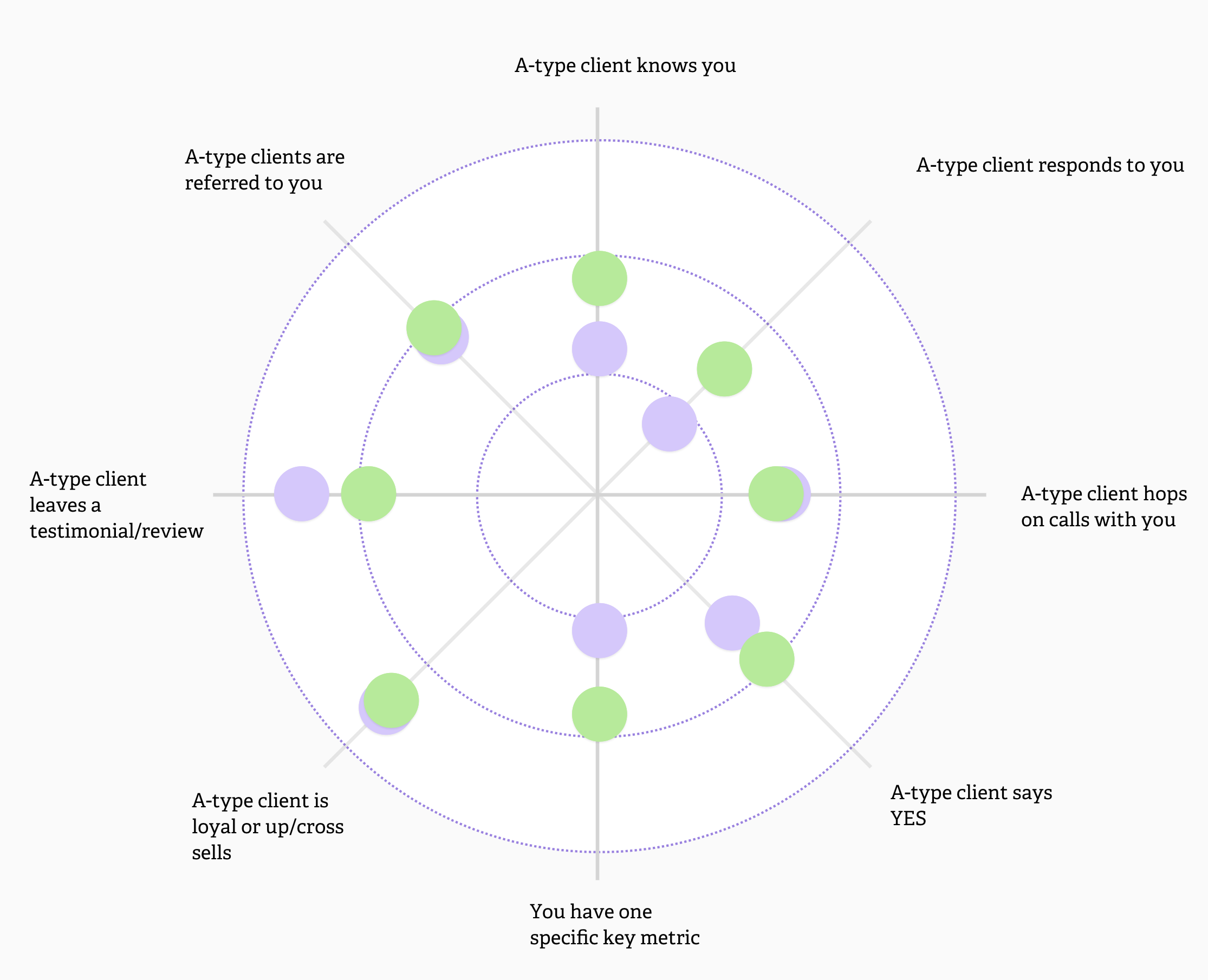
What I see in this image:
Loyal clients who are happy to refer others, leave testimonials and reviews
Clients stay or return because they know I'm legit
Lots of opportunity for attracting new clients, converting new clients, getting eye balls of new clients
Below: the purpose metric. The number that proves my value. Non-monetary, by the way. For me that is the number of commercial ROI-driving aha-moments I reveal to clients.
Then, I tracked the fault lines in my sales assets
My Fault Line Framework is my collection of common revenue-breakers I've seen over the past 20 years which hinder growth or impact. It's not easy to admit this, but I found 8 in my sales and marketing.
The most important ones:
The proof gap. On my website, you can read quantifiable results of customers. Unfortunately, most testimonials lack a client name, context and relevant parameters.
The other thing: most case studies on my website are not tied to my success metric. In other words: they're great, but they don't contribute to what i'm trying to achieve.
The problem: if your proof doesn’t match how decisions are made, you lose deals. Even when they like you.
The misfit ICP. For the past years I've said to sell to “B2B tech scale-ups.”. One tiny (ahem) issue with that... that's not a target audience. It's a category. My clients have a buying committee, with a CFO, a commercial director and integrators who need to work with what I deliver. I need to understand their buying logic, their pain and how they perceive risk.
The problem: If you don't choose a profitable niche and deeply know the buying committee, you simply can't sell.
Narrative Drift. I had an investor saying to me 'I looked at your linkedin posts and I see three different propositions. I have no idea what you're selling".
The problem: Without a repeatable story with strong motives and buyer emotions driving it, your message wont compound.
This is how I did my research
So now we have the central issue laid out in front of me: my message shifts too much. I need to make strategic decisions about who I am, for who I am, with what I am.
No more fuzzy logic.
No more skipping steps and assuming buyers can follow.
(They can't and won't)
It was obviously time to leverage my biggest asset: happy, loyal clients.
What actually makes a buyer stop doubting?
No opinions. No reconstructions. Pure and proven decision logic.
For that I asked questions like:
What was happening the day you knew this had to be solved?
(This reveals the moment doubt turned into urgency.)
What had you already tried before you came to me?
(Reveals fired solutions and why they were fired.)
How did the conversation with your board or CFO go when you wanted to buy this?
(What blocked the decision internally. And what moved it.)
If you’d waited, what would have happened?
(Reveals the real cost of inaction.)
What was the first sign this was working?
(Gives you the proof future buyers need.)
Some of the findings
Some of the signals my research gurgled up:
“We were burning €8k a month on a marketing agency. After six months, still zero ROI. I pulled the plug.”
Buyers are tired of retainers and promises. They want something finite and measurable that optimises processes and workflows (read: performance).
“We need to be certain that our investment [in development] will pay off. I need to validate this business idea.”
“I got a standing ovation from the board after the presentation about your research.”
"We need a playbook for sales"
These statements tell me what to say. And what to build.
(And it sure as hell isnt research or strategy. Buyers aren't buying advice. They're buying credibility)
What you can do in your business
The synthesis of my research isn't done yet.
Eventually, it will lead to a strong pitch deck, rewritten case studies and a content strategy based on the perceptions of my buyers.
But I hope you understand that the question isn't how do I do better marketing or sales?
There's a more important answer now. Which assumptions was I building on... and are they true?
(They weren't. Remember I tried to sell research? No one needs research. They want their sales problem fixed.)
If you want to test this yourself, pull your last three lost deals and ask:
Why did they choose someone else?
What doubt did we fail to resolve?
What proof was missing?
If your answer starts with “I think” or “probably”, you don’t have truth. You have assumptions. And assumptions trickle down all the way to your sales and marketing...